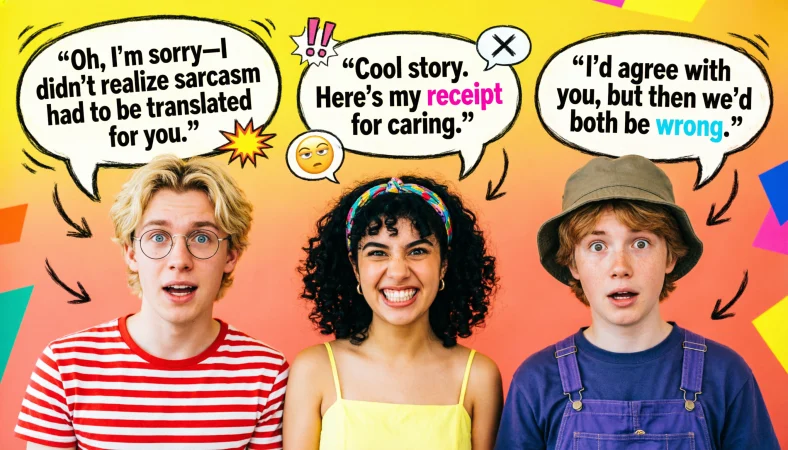
The best comebacks for annoying people are short, confident, and perfectly timed. Whether someone is being nosy, repetitive, rude, or simply doing the absolute most, the right comeback can end the moment without turning it into a whole drama series.
Top alternatives: Noted, and ignored, Please continue, I’ll pretend I care, You’re really committed to this, That sounded better in your head
Some people have a special talent for testing your patience before breakfast. Whether it is a friend who keeps teasing you, a coworker who asks the same question five times, a stranger being unnecessarily rude, or someone flooding your DMs with opinions nobody ordered, annoying behavior can make even the calmest person reach their limit. That is where clever comebacks come in.
The best comebacks for annoying people are not always brutally insulting. Sometimes the funniest response is simply confident, unexpected, and impossible to argue with. A good line can set a boundary, lighten the mood, or remind someone that you are not taking their nonsense seriously. From playful sarcasm to fierce one-liners, this list has something for every level of annoyance. Pick your favorite and keep it ready for your next patience emergency.
Funny Comebacks
“Congratulations, you’ve officially become background noise.”
Use this when someone keeps talking despite getting zero reaction.
Meaning: You are humorously saying their behavior no longer deserves your attention.
“Do you come with an off switch?”
Use this with a friend who has been talking nonstop.
Meaning: You are playfully asking them to give everyone a little peace.
“I admire your commitment to being annoying.”
Use this when someone refuses to quit teasing you.
Meaning: You are calling out their persistence in a funny way.
“You really woke up and chose chaos today.”
Use this when someone’s behavior is unusually irritating.
Meaning: You are jokingly blaming their chaotic energy.
“And the award for most unnecessary commentary goes to you.”
Use this when someone keeps adding unwanted opinions.
Meaning: You are sarcastically highlighting how unnecessary their input is.
“Please hold. Your nonsense is being processed.”
Use this when you want a silly response to an irritating comment.
Meaning: You are pretending their nonsense requires official processing.
“That was a lot of words for absolutely nothing.”
Use this after someone gives a long, pointless explanation.
Meaning: You are jokingly saying their message had no real value.
“You’re really giving my patience a workout.”
Use this when a friend keeps pushing your buttons.
Meaning: You are admitting they are testing your patience.
“I’d respond, but I left my patience at home.”
Use this when someone catches you on a particularly low patience day.
Meaning: You are humorously warning them that you are not in the mood.
“You’re lucky I find this mildly entertaining.”
Use this when someone is annoying but still making you laugh.
Meaning: You are teasing them while admitting their behavior is somewhat amusing.
“This conversation needs a commercial break.”
Use this when an interaction becomes exhausting.
Meaning: You want a pause without making the situation overly serious.
“Somebody give this person a microphone and a timeout.”
Use this when someone is being loud and dramatic.
Meaning: You are joking about their need for attention.
Brutal Comebacks
“I heard you. I just didn’t find it important.”
Use this when someone expects an immediate reaction to their comment.
Meaning: You are calmly showing that their opinion does not matter to you.
“You’re confusing confidence with being annoying.”
Use this when someone acts proud of irritating others.
Meaning: You are pointing out that their behavior is not as impressive as they think.
“You have a lot to say for someone nobody asked.”
Use this when someone gives unsolicited commentary.
Meaning: You are directly calling out their unnecessary opinion.
“Your personality needs a software update.”
Use this when a friend repeatedly behaves irritatingly.
Meaning: You are joking that their behavior needs improvement.
“I’d take you seriously, but you keep making that difficult.”
Use this when someone repeatedly ruins their own credibility.
Meaning: Their behavior makes it hard for you to respect their comments.
“You’re not intimidating. You’re just loud.”
Use this when someone tries to dominate a situation.
Meaning: You are separating confidence from unnecessary aggression.
“That attitude is doing you absolutely no favors.”
Use this when someone is being unnecessarily rude.
Meaning: You are warning them that their behavior reflects badly on them.
“You really overestimate how much I care.”
Use this when someone is trying to provoke you.
Meaning: You are refusing to give them the reaction they want.
“Your opinion arrived without being requested.”
Use this when someone inserts themselves into your business.
Meaning: You are firmly rejecting their unsolicited input.
“I’m not arguing with someone committed to misunderstanding me.”
Use this when a conversation keeps going in circles.
Meaning: You are choosing to end an unproductive argument.
“You’ve mistaken my silence for interest.”
Use this when someone keeps talking despite your lack of response.
Meaning: Your silence does not mean you want the conversation to continue.
“Being louder doesn’t make you more right.”
Use this during an unnecessarily heated discussion.
Meaning: You are reminding someone that volume does not prove their point.
Flirty Comebacks
“Are you always this annoying, or am I just special?”
Use this with someone you secretly enjoy teasing.
Meaning: You are turning their annoying behavior into playful flirting.
“You’re lucky you’re cute.”
Use this when an attractive person is getting on your nerves.
Meaning: You are admitting their charm is saving them.
“Stop being annoying. It’s making me like you.”
Use this when playful chemistry is already obvious.
Meaning: You are disguising attraction as irritation.
“I was going to ignore you, but you’re unfortunately adorable.”
Use this when someone keeps trying to get your attention.
Meaning: You are admitting their charm makes ignoring them difficult.
“Is annoying me your flirting technique?”
Use this when someone keeps teasing you.
Meaning: You are playfully suggesting their teasing is intentional flirting.
“Careful, I might start finding this cute.”
Use this when someone is being playfully irritating.
Meaning: Their annoying behavior is starting to feel charming.
“You’re dangerously close to becoming my favorite distraction.”
Use this when someone keeps stealing your attention.
Meaning: You are admitting you enjoy their presence.
“You’re trouble, and apparently I’m interested.”
Use this when the chemistry feels playful.
Meaning: You are acknowledging attraction despite their mischievous personality.
“Why are you so annoying and so attractive at the same time?”
Use this when someone is both irritating and charming.
Meaning: You are mixing frustration with obvious attraction.
“I should probably stop replying, but here we are.”
Use this when you keep responding despite pretending to be annoyed.
Meaning: You are hinting that you actually enjoy the interaction.
“You’re making it really hard to stay annoyed at you.”
Use this when someone tries to win you over after teasing you.
Meaning: Their charm is softening your irritation.
“Fine, you can keep annoying me.”
Use this when you secretly want the conversation to continue.
Meaning: You are playfully giving them permission to stay close.
Polite Comebacks
“I appreciate your input, but I’ll pass.”
Use this when someone gives unwanted advice.
Meaning: You are rejecting their opinion without being rude.
“Thanks, but I think I’ll handle it my way.”
Use this when someone tries to control your decision.
Meaning: You are calmly reinforcing your independence.
“I understand what you mean. I simply disagree.”
Use this during a disagreement with someone who is becoming irritating.
Meaning: You are keeping the conversation respectful while standing your ground.
“Let’s agree to leave it there.”
Use this when a discussion is becoming repetitive.
Meaning: You want to end the topic peacefully.
“I’d rather not continue this conversation.”
Use this when someone refuses to respect your boundaries.
Meaning: You are clearly choosing to disengage.
“That’s one way to look at it.”
Use this when you disagree but do not want an argument.
Meaning: You are acknowledging their view without endorsing it.
“I’ll keep that in mind.”
Use this when someone gives advice you do not plan to follow.
Meaning: You are politely ending the discussion.
“I think we see this differently.”
Use this when disagreement is becoming personal.
Meaning: You are separating the disagreement from the person.
“Thanks for sharing your perspective.”
Use this when someone insists on giving their opinion.
Meaning: You acknowledge them without inviting further debate.
“I’m comfortable with my decision.”
Use this when someone keeps questioning your choices.
Meaning: You are confidently closing the subject.
“Let’s keep things respectful.”
Use this when someone’s tone becomes inappropriate.
Meaning: You are setting a clear boundary.
“I think this conversation has run its course.”
Use this when you are ready to leave an exhausting discussion.
Meaning: You are politely signaling that the conversation is over.
Professional Comebacks
“Let’s keep the conversation focused on the issue.”
Use this when a coworker keeps going off-topic.
Meaning: You are redirecting the discussion professionally.
“I’d prefer to focus on solutions rather than commentary.”
Use this when someone complains without contributing anything useful.
Meaning: You want productive discussion instead of unnecessary criticism.
“Let’s stick to the facts.”
Use this when someone makes exaggerated claims at work.
Meaning: You are asking for objective information.
“I think we can keep this more constructive.”
Use this when a workplace discussion becomes unnecessarily negative.
Meaning: You are encouraging a more productive tone.
“I’ve noted your concern.”
Use this when someone repeatedly raises the same complaint.
Meaning: You acknowledge them without promising anything further.
“Let’s discuss that when it becomes relevant.”
Use this when someone brings up an unnecessary topic.
Meaning: You are postponing an irrelevant discussion.
“I believe we’ve covered this already.”
Use this when someone keeps repeating themselves.
Meaning: You are professionally signaling that the topic has been addressed.
“Let’s avoid making this personal.”
Use this when workplace criticism crosses a line.
Meaning: You are redirecting the interaction toward professionalism.
“I’m happy to discuss this productively.”
Use this when someone approaches you with unnecessary hostility.
Meaning: You are willing to engage if the conversation stays constructive.
“Could we keep this conversation concise?”
Use this when someone is taking too long to make a simple point.
Meaning: You are asking them to get to the point.
“I’ll respond once there’s something actionable to address.”
Use this when someone sends repeated but unhelpful messages.
Meaning: You are refusing to waste time on pointless discussion.
“Let’s move forward.”
Use this when someone keeps reopening an old issue.
Meaning: You are encouraging everyone to stop dwelling on the past.
Creative Comebacks
“Your notification has been successfully ignored.”
Use this when someone keeps demanding attention.
Meaning: You are creatively telling them their attempt did not work.
“Welcome to the waiting room of my patience.”
Use this when someone is pushing your limits.
Meaning: You are humorously saying your patience is running low.
“Your audition for my attention has ended.”
Use this when someone keeps trying to provoke you.
Meaning: You are playfully withdrawing your attention.
“That comment just took a wrong turn at Common Sense Street.”
Use this after a particularly ridiculous statement.
Meaning: You are joking about how unreasonable the comment sounds.
“Your drama subscription has expired.”
Use this when someone keeps creating unnecessary problems.
Meaning: You are refusing to participate in their drama.
“Please place your nonsense in the suggestion box.”
Use this when someone has too many unnecessary opinions.
Meaning: You are jokingly sending their comments somewhere irrelevant.
“My patience has entered airplane mode.”
Use this when you are done dealing with someone.
Meaning: You are temporarily unavailable for their nonsense.
“That opinion has been filed under ‘not my problem.’”
Use this when someone gives unsolicited advice.
Meaning: You are choosing not to engage with their opinion.
“You’ve unlocked a new level of unnecessary.”
Use this when someone’s behavior is particularly pointless.
Meaning: You are humorously calling out their excess.
“Your drama has been detected and declined.”
Use this when someone tries to pull you into an argument.
Meaning: You are refusing to participate.
“I’d like to thank you for today’s episode of Absolutely Nobody Asked.”
Use this after someone gives unwanted commentary.
Meaning: You are jokingly dismissing their opinion.
“Please enjoy your complimentary reality check.”
Use this when someone needs a gentle but sharp reminder.
Meaning: You are suggesting they rethink their behavior.
Sarcastic Comebacks
“Wow, what a groundbreaking observation.”
Use this when someone states something extremely obvious.
Meaning: You are sarcastically pretending their comment is brilliant.
“Thanks for the update nobody requested.”
Use this when someone gives unnecessary information.
Meaning: You are teasing them for oversharing.
“I’ll alert the authorities immediately.”
Use this when someone dramatically exaggerates a minor problem.
Meaning: You are mocking their unnecessary seriousness.
“Oh no, whatever will I do with that information?”
Use this when someone shares something irrelevant.
Meaning: You are joking that their information has no impact on you.
“Please tell me more. I was almost enjoying the silence.”
Use this when someone talks too much.
Meaning: You are sarcastically suggesting you preferred the quiet.
“Truly inspiring. I’ll try to recover.”
Use this when someone makes a mildly irritating comment.
Meaning: You are exaggerating how deeply their words affected you.
“How brave of you to say something so unnecessary.”
Use this when someone offers an unwanted opinion.
Meaning: You are sarcastically criticizing their timing.
“You really thought that was the moment, huh?”
Use this when someone makes an awkward or unnecessary remark.
Meaning: You are playfully questioning their decision to speak.
“I’m amazed by your ability to miss the point.”
Use this when someone repeatedly misunderstands you.
Meaning: You are sarcastically highlighting their lack of understanding.
“Ten out of ten for confidence, questionable score for relevance.”
Use this when someone speaks confidently about something unrelated.
Meaning: You are separating their confidence from the usefulness of their comment.
“That was certainly a sentence.”
Use this when someone says something ridiculous.
Meaning: You are sarcastically refusing to give their statement serious praise.
“Thank you for your TED Talk.”
Use this when someone gives an unnecessarily long lecture.
Meaning: You are jokingly signaling that their speech is over.
Cute Comebacks
“You’re annoying, but I’ll allow it.”
Use this with a friend you genuinely like.
Meaning: You are showing affection through playful teasing.
“Okay, little menace.”
Use this when someone is being mischievous.
Meaning: You are teasing them affectionately.
“Stop being so adorable while annoying me.”
Use this when their irritating behavior is actually charming.
Meaning: You are mixing affection with playful frustration.
“You’re lucky I like you.”
Use this when a friend keeps teasing you.
Meaning: Your affection is keeping you from getting genuinely annoyed.
“Tiny menace energy detected.”
Use this when someone is acting mischievously.
Meaning: You are playfully labeling their chaotic behavior.
“You’re officially on my patience list.”
Use this with someone who keeps testing you.
Meaning: You are jokingly warning them that they are pushing limits.
“Okay, chaos cupcake.”
Use this when someone is being cute but disruptive.
Meaning: You are giving their annoying behavior an affectionate twist.
“I’m pretending to be annoyed because you’re too cute.”
Use this when teasing someone you care about.
Meaning: Your irritation is mostly playful affection.
“You make being annoyed weirdly fun.”
Use this when someone keeps joking around.
Meaning: You are admitting you enjoy the interaction.
“Fine, you win this round, troublemaker.”
Use this after someone successfully teases you.
Meaning: You are playfully accepting defeat.
“You’re my favorite little headache.”
Use this with a close friend or romantic interest.
Meaning: You are saying they can be annoying while still being special.
“Annoying level: cute enough to survive.”
Use this when someone gets away with teasing you.
Meaning: Their charm makes their annoying behavior forgivable.
Dramatic Comebacks
“This is how my villain origin story begins.”
Use this when someone annoys you over something tiny.
Meaning: You are dramatically exaggerating the situation for humor.
“I will never emotionally recover from this.”
Use this after a ridiculous but harmless comment.
Meaning: You are pretending their comment devastated you.
“The betrayal. The disrespect. The audacity.”
Use this when someone does something mildly irritating.
Meaning: You are turning a small annoyance into comedy.
“My patience has officially left the building.”
Use this when you have had enough.
Meaning: You are dramatically announcing that your patience is gone.
“Someone document this moment for history.”
Use this when something ridiculous happens.
Meaning: You are exaggerating the importance of the moment.
“I cannot believe I have to witness this with my own eyes.”
Use this when someone does something absurd.
Meaning: You are humorously expressing exaggerated disbelief.
“Call the committee. We have an emergency.”
Use this when someone creates unnecessary drama.
Meaning: You are pretending the situation requires official intervention.
“This level of nonsense deserves its own documentary.”
Use this when someone is being exceptionally ridiculous.
Meaning: You are exaggerating their behavior for comedic effect.
“I need a moment to process this betrayal.”
Use this when a friend does something mildly annoying.
Meaning: You are playfully pretending to be deeply hurt.
“I have seen enough. Roll credits.”
Use this when you are done with an interaction.
Meaning: You are dramatically ending the situation.
“My peace has been personally attacked.”
Use this when someone interrupts your calm.
Meaning: You are humorously defending your need for peace.
“This plot twist was completely unnecessary.”
Use this when someone suddenly creates a problem.
Meaning: You are joking about their unexpected drama.
Chill And Casual Comebacks
“Haha, anyway…”
Use this when you want to move past an annoying comment.
Meaning: You are refusing to give the comment much attention.
“We’re not doing this today.”
Use this when someone starts unnecessary drama.
Meaning: You are calmly declining to participate.
“Yeah, I’m gonna pass on that.”
Use this when someone suggests something you do not want.
Meaning: You are casually rejecting the idea.
“Not really my problem, honestly.”
Use this when someone tries to involve you in their issue.
Meaning: You are creating distance from unnecessary drama.
“Let’s not make this bigger than it is.”
Use this when someone overreacts.
Meaning: You are encouraging them to calm down.
“I’m good, thanks.”
Use this when someone keeps offering unwanted advice.
Meaning: You are politely ending the interaction.
“Nah, we’re good.”
Use this when you want to shut down a pointless argument.
Meaning: You are choosing not to engage.
“I’m not getting into all that.”
Use this when someone tries to pull you into gossip.
Meaning: You are keeping yourself out of unnecessary drama.
“Cool story.”
Use this when someone says something you do not care about.
Meaning: You are lightly dismissing their comment.
“Fair enough. Moving on.”
Use this when you acknowledge someone without wanting to debate.
Meaning: You are accepting the comment and ending the subject.
“Okay, noted.”
Use this when someone gives you unnecessary information.
Meaning: You acknowledge them without encouraging more discussion.
“You do you.”
Use this when someone insists on doing something their way.
Meaning: You are letting them make their own choice without arguing.
Confident Comebacks
“I know who I am, so that doesn’t bother me.”
Use this when someone tries to criticize or provoke you.
Meaning: Your confidence prevents their words from controlling your mood.
“You don’t have to agree with me.”
Use this when someone keeps challenging your choices.
Meaning: You are comfortable with disagreement.
“I’m not here to impress you.”
Use this when someone judges your behavior unnecessarily.
Meaning: You are refusing to seek their approval.
“I’m comfortable with myself.”
Use this when someone tries to make you insecure.
Meaning: You are showing self-confidence.
“That’s your opinion, not my reality.”
Use this when someone makes a personal judgment about you.
Meaning: You are separating their perception from your identity.
“I don’t need to explain every decision I make.”
Use this when someone becomes overly curious about your choices.
Meaning: You are asserting your independence.
“I said what I said.”
Use this when someone keeps trying to change your mind.
Meaning: You are standing firmly behind your position.
“I’m not interested in proving myself to you.”
Use this when someone challenges your worth.
Meaning: You are refusing to participate in a validation contest.
“You can think whatever you want.”
Use this when someone wants you to defend yourself endlessly.
Meaning: You are confidently allowing them to have their opinion.
“I’m choosing peace over this conversation.”
Use this when an argument is becoming exhausting.
Meaning: You value your peace more than winning the argument.
“My boundaries aren’t up for debate.”
Use this when someone repeatedly ignores your limits.
Meaning: You are clearly reinforcing your boundaries.
“I don’t have anything to prove here.”
Use this when someone tries to challenge your confidence.
Meaning: You are refusing to compete for approval.
Emotional Comebacks
“Honestly, that bothered me more than you realize.”
Use this when someone’s annoying behavior actually hurt you.
Meaning: You are communicating genuine emotional impact.
“I’d rather you respect my feelings.”
Use this when someone dismisses your reaction.
Meaning: You are asking for emotional consideration.
“I’m trying to stay calm, but this is frustrating.”
Use this when you want to express irritation honestly.
Meaning: You are explaining your emotional state without attacking them.
“I don’t want this to turn into an argument.”
Use this when tension is rising.
Meaning: You want to protect the relationship from unnecessary conflict.
“I need some space right now.”
Use this when someone has pushed your patience too far.
Meaning: You are asking for time to calm down.
“I care about you, but I don’t like being treated this way.”
Use this with someone close who repeatedly crosses a line.
Meaning: You are combining affection with a clear boundary.
“That wasn’t okay with me.”
Use this when someone’s behavior genuinely crossed a boundary.
Meaning: You are clearly communicating discomfort.
“I wish you would understand where I’m coming from.”
Use this when someone keeps misunderstanding your perspective.
Meaning: You want empathy rather than another argument.
“I’m not angry, I’m just disappointed.”
Use this when someone repeatedly lets you down.
Meaning: Their behavior has affected your trust or expectations.
“I don’t want to keep repeating myself.”
Use this when someone ignores what you have already explained.
Meaning: You are frustrated by the lack of progress.
“Can we talk about this without attacking each other?”
Use this when an argument becomes personal.
Meaning: You want a healthier conversation.
“I just want to be heard.”
Use this when someone keeps interrupting or dismissing you.
Meaning: You are asking for basic attention and understanding.
Sweet Comebacks
“I know you mean well, but I’m okay.”
Use this when someone annoys you while trying to help.
Meaning: You appreciate their intention while setting a gentle boundary.
“You’re forgiven, but don’t make it a habit.”
Use this with someone who mildly annoys you.
Meaning: You are accepting their behavior while playfully warning them.
“I know you’re joking, but be nice to me.”
Use this when teasing crosses your comfort zone.
Meaning: You are asking for kindness without escalating the situation.
“I appreciate you, just not this behavior.”
Use this with someone you care about.
Meaning: You are separating the person from their irritating action.
“Let’s reset and start over.”
Use this after an interaction becomes unnecessarily tense.
Meaning: You want to move forward without holding onto the argument.
“I’d rather laugh about this than fight about it.”
Use this when a silly disagreement starts getting serious.
Meaning: You want to protect the mood and relationship.
“You know I care about you, right?”
Use this before addressing an annoying habit with someone close.
Meaning: You are softening the criticism with genuine affection.
“We’re okay. Just give me a minute.”
Use this when you need temporary space from someone.
Meaning: You are asking for time without creating unnecessary worry.
“I’m not mad, just slightly over it.”
Use this when someone’s behavior has become tiring.
Meaning: You are expressing mild frustration without hostility.
“Let’s keep the good vibes alive.”
Use this when you want to steer a conversation away from negativity.
Meaning: You are encouraging everyone to lighten the mood.
“I know you can do better than that.”
Use this when someone close behaves in a disappointing way.
Meaning: You are holding them accountable while showing that you expect better.
“Okay, peace treaty accepted.”
Use this after a playful disagreement.
Meaning: You are happily ending the conflict.
Clever Comebacks
“Interesting theory. The evidence is still loading.”
Use this when someone makes an unsupported claim.
Meaning: You are cleverly questioning whether their statement is credible.
“I’d explain it, but I don’t think we have enough time.”
Use this when someone repeatedly misunderstands something obvious.
Meaning: You are teasing them about their lack of understanding.
“Your confidence is impressive. Your accuracy needs work.”
Use this when someone speaks confidently but incorrectly.
Meaning: You are separating their certainty from the facts.
“That sounds like a problem for future you.”
Use this when someone complains about a situation they created.
Meaning: You are jokingly refusing responsibility for their issue.
“I’ll put that under ‘things I didn’t need to know.’”
Use this when someone overshares.
Meaning: You are humorously dismissing unnecessary information.
“You’ve made a strong case for silence.”
Use this when someone keeps talking without making sense.
Meaning: Their comments are making you appreciate quiet.
“That argument has more holes than a slice of Swiss cheese.”
Use this when someone presents a weak argument.
Meaning: You are pointing out that their reasoning is full of flaws.
“I respect the creativity, not the logic.”
Use this when someone makes a wild excuse.
Meaning: Their explanation is imaginative but unconvincing.
“You almost had a point there.”
Use this when someone makes a nearly reasonable but flawed argument.
Meaning: You are teasing them about missing the mark.
“Let’s put that idea back in the oven.”
Use this when someone’s suggestion clearly needs more work.
Meaning: You are humorously suggesting they rethink it.
“Your timing deserves a standing ovation.”
Use this when someone says something awkward at exactly the wrong moment.
Meaning: You are sarcastically praising their terrible timing.
“That was confidently incorrect.”
Use this when someone is completely wrong but extremely sure of themselves.
Meaning: You are humorously highlighting the mismatch between confidence and accuracy.
Witty Comebacks
“You really make silence look underrated.”
Use this when someone has been talking nonstop.
Meaning: You are jokingly saying their conversation is exhausting.
“I’d agree with you, but then we’d both be wrong.”
Use this when someone makes a ridiculous claim.
Meaning: You are delivering a classic playful dismissal.
“You’re doing a lot for someone who could simply relax.”
Use this when someone is being unnecessarily dramatic.
Meaning: You are encouraging them to calm down.
“You have a gift for making simple things complicated.”
Use this when someone overcomplicates an easy situation.
Meaning: You are teasing them about their unnecessary complexity.
“I see the confidence. I’m still searching for the reason.”
Use this when someone acts overly confident.
Meaning: You are humorously questioning what justifies their attitude.
“That sounded much better in your head, didn’t it?”
Use this after someone makes an awkward remark.
Meaning: You are teasing them for misjudging how their comment would land.
“You’re really committed to this bit.”
Use this when someone refuses to stop a joke or argument.
Meaning: You are pointing out their persistence in a funny way.
“I’m impressed by how confidently you missed the point.”
Use this when someone misunderstands you.
Meaning: You are joking about their complete lack of understanding.
“You’ve certainly chosen a hill to stand on.”
Use this when someone stubbornly defends a silly opinion.
Meaning: You are highlighting how committed they are to their position.
“That’s certainly one interpretation.”
Use this when someone’s understanding is questionable.
Meaning: You are politely suggesting their interpretation may be wrong.
“Your logic took a scenic route.”
Use this when someone’s reasoning is unnecessarily complicated.
Meaning: You are teasing them about their unusual thought process.
“I’ll give you points for enthusiasm.”
Use this when someone tries very hard but misses the mark.
Meaning: You are acknowledging their effort without agreeing with them.
Amazing But Funny Comebacks
“I’m not saying you’re annoying, but my battery drops around you.”
Use this when a friend constantly drains your energy.
Meaning: You are joking that their presence is exhausting.
“You have the confidence of someone who has never checked the group chat.”
Use this when someone acts overly certain.
Meaning: You are playfully questioning their awareness.
“If unnecessary commentary were a sport, you’d be undefeated.”
Use this when someone always has something to say.
Meaning: You are humorously calling out their constant commentary.
“You’re proof that volume and wisdom are unrelated.”
Use this when someone gets louder instead of making sense.
Meaning: You are pointing out that being loud does not make them correct.
“I’d roast you, but life seems to be handling that already.”
Use this when someone is being confidently ridiculous.
Meaning: You are joking that their own behavior is already embarrassing enough.
“You bring main-character energy to a background-character situation.”
Use this when someone makes themselves the center of attention unnecessarily.
Meaning: You are teasing them for overestimating their importance in the moment.
“Your audacity deserves its own Wi-Fi network.”
Use this when someone is exceptionally bold.
Meaning: You are exaggerating their confidence for comedic effect.
“You really said that with your whole chest.”
Use this when someone confidently says something ridiculous.
Meaning: You are amused by how boldly they delivered it.
“I’m trying to decide whether to laugh or schedule a meeting about this.”
Use this when someone creates unnecessary drama.
Meaning: You are exaggerating the seriousness of their behavior.
“You have never met an unnecessary thought you didn’t want to share.”
Use this when someone overshares constantly.
Meaning: You are teasing them for having no filter.
“Your timing is almost impressively terrible.”
Use this when someone makes awkward comments at the worst possible time.
Meaning: You are humorously criticizing their timing.
“Honestly, your persistence is almost inspiring.”
Use this when someone refuses to stop annoying you.
Meaning: You are sarcastically admiring their dedication to being irritating.
Boundary-Setting Comebacks
“I’m not comfortable with that.”
Use this when someone crosses a personal boundary.
Meaning: You are clearly communicating discomfort.
“Please stop.”
Use this when someone continues behavior after you have already objected.
Meaning: You are giving a direct and unmistakable boundary.
“That’s not something I want to discuss.”
Use this when someone asks an overly personal question.
Meaning: You are choosing not to share that information.
“I’ve answered that already.”
Use this when someone repeatedly asks the same question.
Meaning: You are making it clear that you have nothing more to add.
“I need you to respect that.”
Use this when someone ignores your stated boundary.
Meaning: You are asking for your limits to be taken seriously.
“That topic is off-limits.”
Use this when someone keeps bringing up something personal.
Meaning: You are clearly closing that subject.
“I’m not available for this kind of conversation.”
Use this when someone approaches you with unnecessary conflict.
Meaning: You are choosing not to engage.
“You can disagree without being disrespectful.”
Use this when someone becomes rude during a disagreement.
Meaning: You are defending respectful communication.
“I’m ending this conversation now.”
Use this when someone refuses to stop arguing.
Meaning: You are taking control of the interaction.
“My answer is still no.”
Use this when someone keeps pushing after you decline.
Meaning: You are reinforcing your decision firmly.
“That doesn’t work for me.”
Use this when someone pressures you into something.
Meaning: You are rejecting the situation without unnecessary explanation.
“Please don’t cross that line again.”
Use this when someone has already ignored a boundary.
Meaning: You are making the consequence of repeated behavior clear.
Comebacks For Friends Who Won’t Stop Teasing
“You’re getting dangerously close to losing your friendship privileges.”
Use this when a friend takes teasing too far.
Meaning: You are playfully warning them to stop.
“Keep going and I’m changing your contact name.”
Use this when a friend refuses to stop joking.
Meaning: You are teasing them with a harmless consequence.
“You really woke up determined to test this friendship.”
Use this when their teasing becomes relentless.
Meaning: You are joking about how far they are pushing you.
“Friendship revoked for five business minutes.”
Use this when you want a dramatic but harmless response.
Meaning: You are pretending to temporarily cancel the friendship.
“Your teasing privileges have been suspended.”
Use this after a friend takes a joke too far.
Meaning: You are playfully establishing a temporary boundary.
“I’m keeping receipts, bestie.”
Use this when your friend gives you future blackmail material.
Meaning: You are joking that you will remember their behavior.
“You’re lucky we have history.”
Use this when an old friend annoys you.
Meaning: Your friendship gives them extra tolerance.
“I know where you live, emotionally.”
Use this when joking with a close friend.
Meaning: You are playfully saying you know exactly how to tease them back.
“This friendship is becoming a hostile takeover.”
Use this when the teasing gets intense.
Meaning: You are humorously exaggerating the situation.
“You’re testing the friendship warranty.”
Use this when someone keeps pushing your buttons.
Meaning: You are joking that their behavior may void your friendship agreement.
“Okay, comedian, take five.”
Use this when a friend will not stop making jokes.
Meaning: You are playfully asking them to take a break.
“I’ll remember this during your next crisis.”
Use this when a friend annoys you but you still care about them.
Meaning: You are jokingly threatening playful revenge later.
FAQs
What Does It Mean When Someone Is Being Annoying?
It usually means their behavior is repeatedly irritating, intrusive, rude, repetitive, loud, or attention-seeking. The best response depends on whether they are joking or genuinely crossing a boundary.
Are Funny Comebacks Better Than Brutal Ones?
Usually, yes, especially with friends or people you still want a good relationship with. Humor can shut down annoying behavior without creating unnecessary drama.
Can I Use These Comebacks With Someone I Like?
Absolutely. Flirty and playful comebacks can turn mild annoyance into banter. Just make sure the other person understands your humor.
What If Someone Is Actually Being Disrespectful?
Use a direct boundary instead of relying on sarcasm. A simple “Please stop” or “That’s not okay with me” can be much more effective.
Are These Comebacks Appropriate At Work?
Stick with professional responses in workplace situations. Clever does not have to mean rude, and keeping things calm can protect your reputation.
What If I Don’t Actually Mean the Comeback?
Do not force a joke when you are genuinely upset. A straightforward response is often better than saying something funny that you might regret later.
Can Sarcasm Make Things Worse?
Yes. Sarcasm can be hilarious with the right audience but may sound hostile in serious situations. Read the room before dropping the brutal line.
What Is the Best Comeback for Someone Who Keeps Annoying Me?
A confident boundary usually works best: “I’m not interested in continuing this.” It is short, clear, and does not give the other person much room to argue.
Should I Ignore Annoying People Instead?
Sometimes ignoring them is the ultimate comeback. If someone is clearly trying to provoke you, giving them no reaction can take away the attention they want.
Conclusion
Annoying people are everywhere, but that does not mean they deserve unlimited access to your patience. The right comeback can make a boring interaction funny, turn awkward moments into memorable ones, or simply remind someone where your boundaries are. You do not always need the harshest line either. Sometimes confidence, humor, or a simple “I’m not doing this today” says everything.
Choose your response based on the person, the situation, and the energy you want to bring. Save these comebacks for your next patience emergency, send your favorites to your funniest friend, and keep a few ready for those truly unforgettable moments. Stay clever, stay confident, and never let unnecessary drama steal your vibe.